Numerical Methods
Tensor networks & quantum mechanics
A tensor network usually refers to a decomposition of a high-rank tensor into the product of a bunch of lower-rank tensors. If this decomposition has some regular structure, then we might refer to it as a network. High-ranking tensors can always be broken down like this, but the usefulness of this procedure (from a computational perspective) really comes from the ability to perform approximate decompositions. That is to say, we almost always want to construct tensor networks that keep only the “most important” information from the original high-rank tensor. What results from this is a compressed version of a quantum state that can be efficiently stored and manipulated, much like compressed images on your computer.
So what does this have to do with quantum mechanics? It turns out that the quantum wavefunction for discrete systems (i.e. systems on a lattice, where particles or spins can only sit on particular sites) can be interpreted as a high-rank tensor, where the tensor rank is equal to the number of physical sites. One can then perform an approximate decomposition of that tensor into the product of local tensors – one for each physical site. In general, this kind of a decomposition (which is local in real space) creates a tensor network known as a projected entangled pair state (PEPS). In one spatial dimension, the PEPS state is referred to as a matrix product state (MPS). This one-dimensional tensor network has a lot of of particularly nice properties, and a suite of tools have been developed in recent years to optimize and time-evolve them, among other things.
Research Highlights
Checkerboard Bose Hubbard ladders using transmon arrays
Pranjal Praneel, Thomas G. Kiely, Andre G. Petukhov and Erich J. Mueller
Continuous Wigner-Mott transitions at \(\nu=1/5\)
Thomas G. Kiely and Debanjan Chowdhury
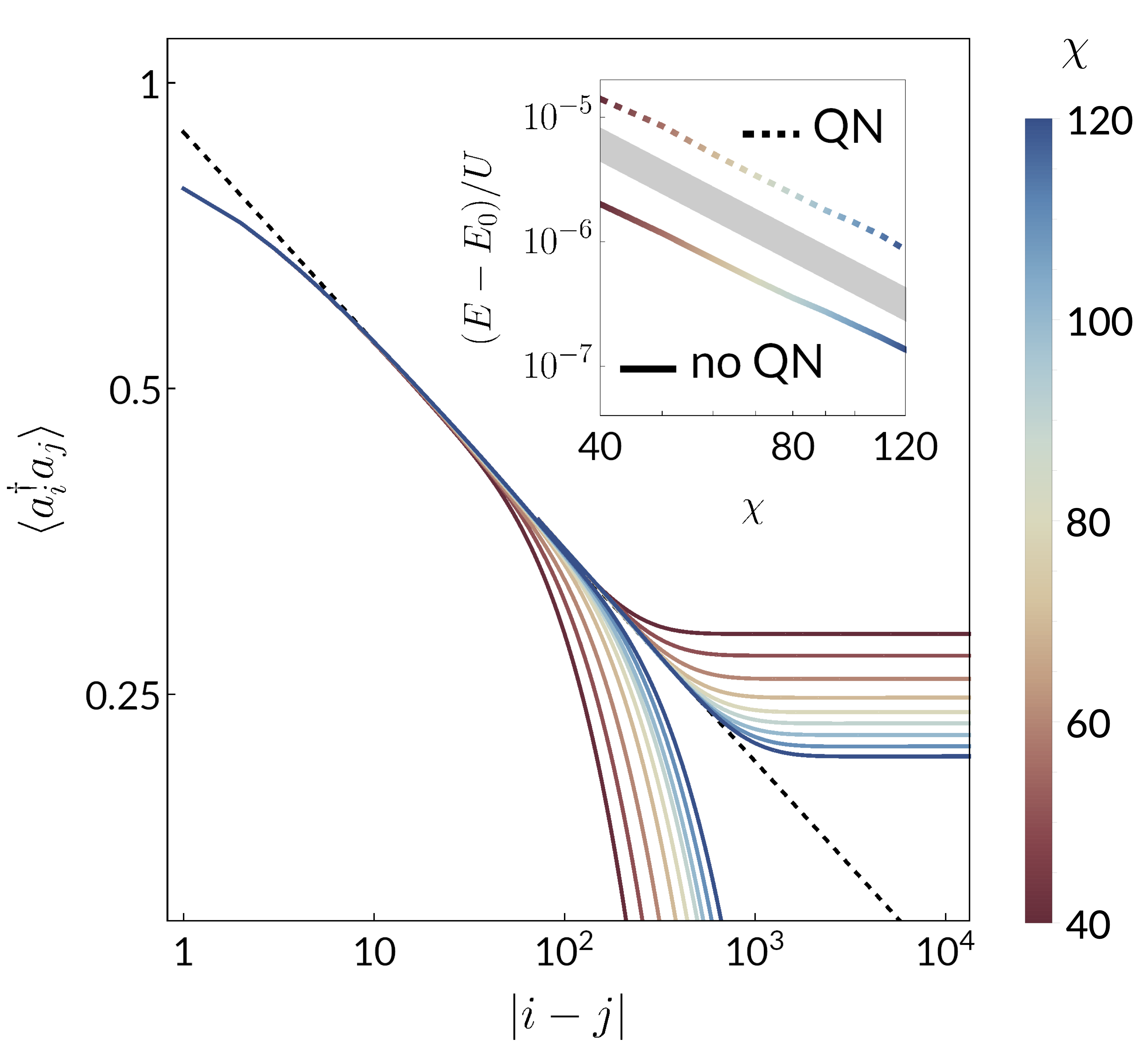
Role of conservation laws in the Density Matrix Renormalization Group
Thomas G. Kiely and Erich J. Mueller