
Strongly-Correlated Phases

Background
We’re all familiar with finite-temperature phases: ice, water, air, etc. In our everyday experience, the transitions between these phases are driven by changes in temperature, which simply the average kinetic energy of the molecules. When the temperature is very low, water molecules stick together and form a crystalline structure. When the temperature is very high, the molecules spread out so that they can move around more easily. In this gaseous phase, those sticky interactions become less important. Interestingly, at an intermediate temperature scale the molecules form a liquid: they spread out enough to move around a bit, but interactions remain important.
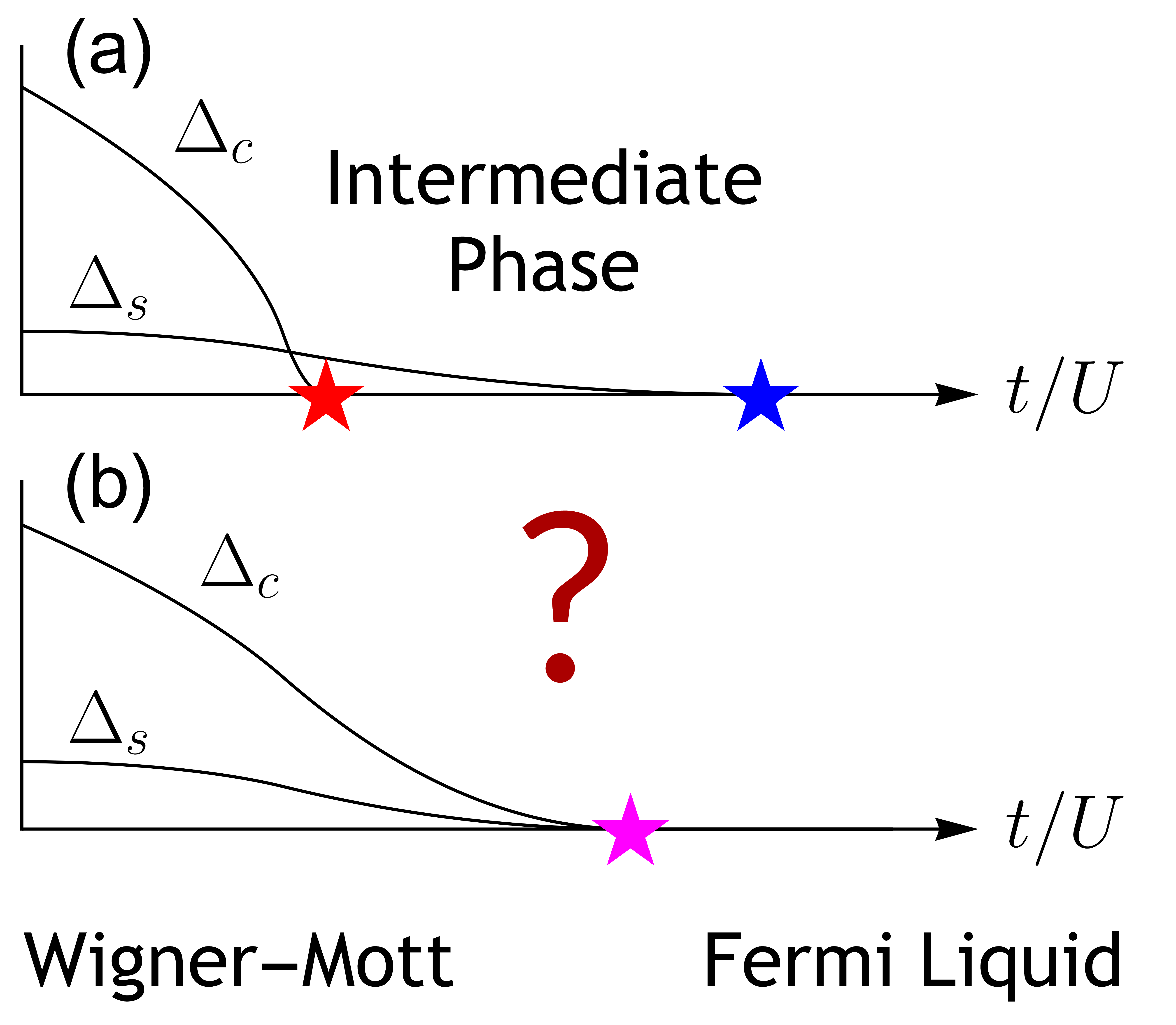
Phase transitions are not all driven by temperature. For example, the phase diagram of water depends also on the ambient pressure. In my work, I have thought about phase transitions that occur at zero temperature. In these systems, particles at zero temperature still have some finite kinetic energy due to quantum fluctuations. Hence, one might find liquid-like and solid-like phases separated by a phase transition that depends on the ratio of the kinetic and interaction energies. One of the crowning achievements of AMO quantum simulators and artificial quantum materials, such as ultra-cold atoms and van der Waals heterostructures, is the demonstration of the ability to tune this ratio and observe such low-temperature quantum phase transitions. In these settings, we have a much greater control over the degrees of freedom than in conventional materials, allowing us to learn about the rich mechanisms driving these transitions and stabilizing different quantum phases.
Research Highlights
Observation of disorder-induced superfluidity
Google Quantum AI and collaborators
Continuous Wigner-Mott transitions at \(\nu=1/5\)
Thomas G. Kiely and Debanjan Chowdhury
Superfluidity in the 1D Bose-Hubbard model
Thomas G. Kiely and Erich J. Mueller